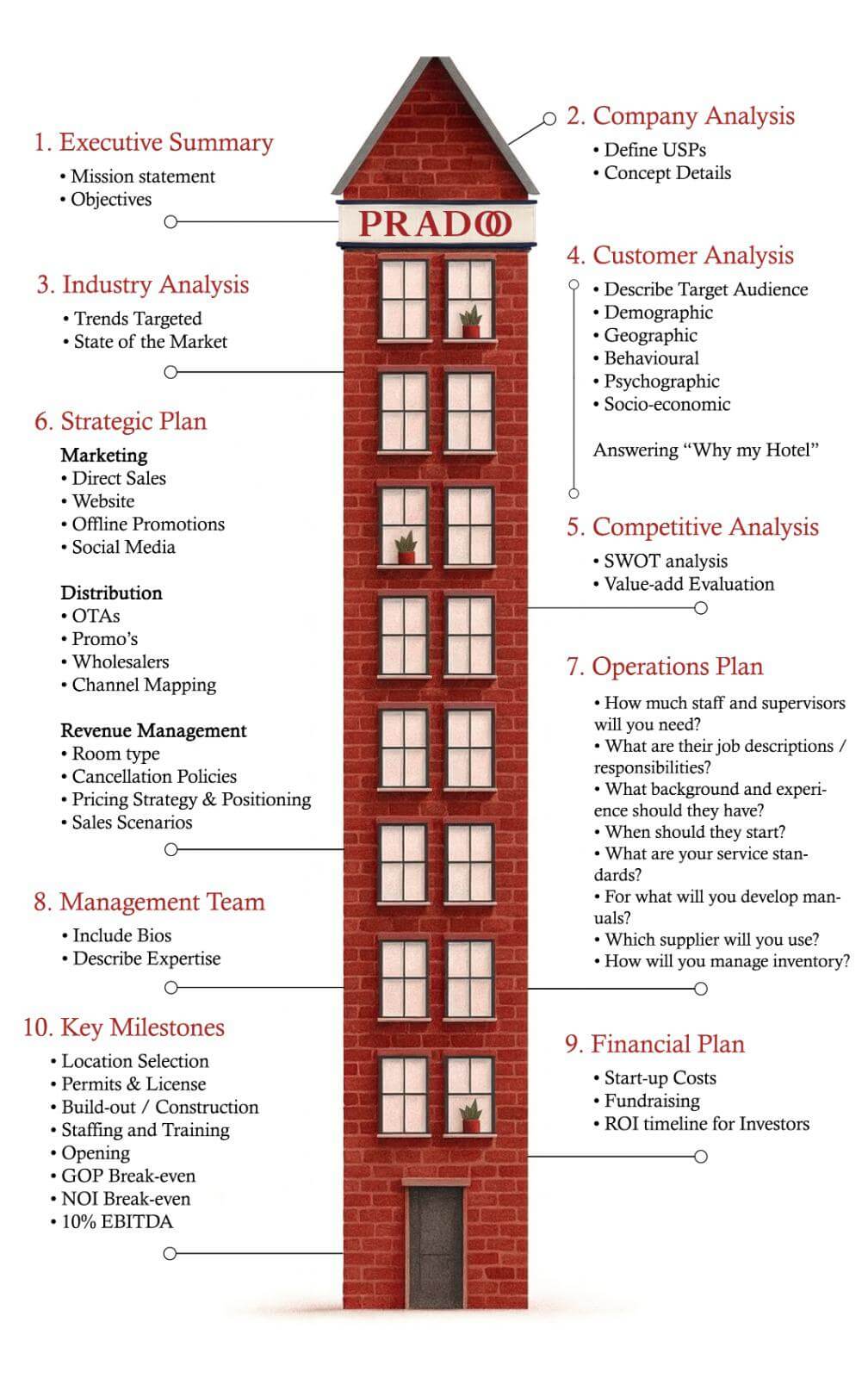
1. Executive Summary and Mission
Prado redefines modern urban hospitality. Here, the guest does not stay in a room but in an experience carefully crafted around the best side of the city. Luxury is no longer about display; it is elegance in simplicity, ease in technology, and sincerity in people.
Mission:
To combine contemporary design, local culture, and technology-driven service to deliver unforgettable stays while providing investors with sustainable, above-market returns.
Model Reality:
Today, city hospitality is trapped between two extremes: the large but soulless structure of chains and the unmanaged nature of amateur boutiques. Prado fills this gap: scalable, professional, yet human.
The strength of the model for investors:
Profitable yet manageable.
Experience-driven yet low on fixed costs.
Perceived as luxury yet flexible in pricing.
This new approach is a high-touch, low-cost concept: fewer staff, higher guest engagement, lower fixed investment, and high perceived value.
2. Company Analysis – The Prado Hospitality Model
Prado Hospitality is a management brand that redefines modern hospitality in city centers. Lean structure, high service, measurable results: each Prado hotel carries the balance of efficiency and emotion.
Innovative Elements:
Reception-free check-in in the lounge; saves two staff members and creates a personal bond.
Show kitchen with fresh sourcing; low CAPEX, high perceived value.
Urban Wellness Lab: not a mini spa but short rituals and breathing therapies for high space efficiency.
Digital concierge and CRM: 24/7 personal communication with guests for speed, loyalty, and data-driven service.
Pradox products: toiletries, coffee, scent, textile, and wine lines for additional revenue and brand attachment.
Prado does not place technology above people; it makes it a quiet extension of elegance.
3. Market Analysis
Global trends strongly support the Prado model:
Bleisure travel and short extended stays are increasing.
Demand for contactless yet high-quality experiences is growing.
Local, sustainable, and authentic concepts are preferred.
Direct booking share is rising rapidly.
Traditional restaurants are being replaced by micro social spaces.
Prado stands at the center of this shift: small, smart, digital, and profitable.
4. Customer Segments and Urban Soul
Each Prado hotel reflects the spirit of its city: architecture inspired by local design, coffee from neighborhood roasters, walls adorned with works by local artists. This approach is called Urban Soul, the emotional bond Prado forms with the city.
Target Segments:
City explorers (25–45): simple, stylish, experience-driven.
Bleisure professionals (28–55): quiet rooms, fast check-in, great coffee.
Creative communities: events, networking, co-working spaces.
Affluent local audience: rooftop, spa, and lounge use.
5. Competition and Differentiation
Prado is not the closing chapter of traditional hospitality; it is the first paragraph of the future of urban hospitality.
Five Key Differentiators:
Reception-free check-in: friendly, fast, and personal.
Show kitchen: theatrical service, low investment.
Urban Wellness Lab: high return from small space.
Digital concierge: live guest contact, fast solutions.
Pradox products: branded experiences and extra income.
Prado defines luxury not in display but in flow, quietness, and human detail.
6. Strategic Plan
Brand and Marketing:
Mobile-first website, neighborhood guides, local event partnerships. Quarterly themed campaigns: Local Flavours, Design Week, Prado Wellness.
Distribution:
OTA 45%, Direct 40%, Corporate 15%. Google Hotel Ads and brand.com loyalty advantages.
Revenue Management:
Dynamic pricing with an ADR target of 150 euros. Segment-based forecasting, in-season rate fencing, and probability oversell management.
7. Operations and Team
A total of 55 staff for 100 rooms.
The structure is lean yet built on high service standards.
General Management: 2 people
Guest Relations: 7 people, lounge check-in and digital concierge
Housekeeping: 11 people, digital reporting system
F&B (Kitchen and Bar): 12 people, show kitchen and barista culture
SPA and Wellness: 4 people, Urban Wellness Lab
Technical Services: 3 people, IoT energy tracking
Procurement and Storage: 2 people, e-procurement system
Finance and HR: 3 people
Sales and Marketing: 4 people
Security: 4 people
Support Services: 3 people
8. Financial Summary
The Prado model achieves profitability not by cutting costs but by increasing perceived value. Every square meter earns more because guests invest in an experience that feels worth more than they pay.
ADR: 150 euros
Occupancy: 70–75%
EBITDA: around 15%
ROI: 7–10 years
Break-even occupancy: 55%
Revenue model: management and royalty fees totaling 6–7% of room revenue.
9. Sustainability and Governance
Energy, water, and waste management are monitored digitally. Local supply chains, employment, and community projects are central to the brand. A performance and sustainability report is prepared every quarter. Prado measures social benefit alongside financial profit, believing that for luxury to be lasting, it must also be responsible.
10. Roadmap and Scalability
Location Selection: Months 0–2, feasibility and market analysis
Permits and Licensing: Months 2–5, zoning and health processes
Fit-Out and Design: Months 4–18, construction, interiors, SPA and kitchen setup
Systems and Team: Months 18–22, PMS, POS, CRM, Prado SOP training
Soft Opening: Month 23, trial stays
Grand Opening: Month 24, launch and media introduction
NOI Break-even: Month 24
EBITDA 10%: Month 30
Scalability Vision:
This model can start in Bursa but can be replicated with the same efficiency in cities like Istanbul, Izmir, Baku, or Amman. One business model, a multi-city soul: the growth of Prado is based on this principle.
Conclusion
Prado Luxury Boutique City Hotel leaves behind traditional hospitality and writes the future of urban hospitality. With reception-free check-in, show kitchen, Urban Wellness Lab, digital concierge, and Pradox products, it redefines luxury.
This model is scalable yet human, high-touch yet low-cost, luxurious yet accessible.
ADR 150 euros, occupancy 72%, ROI 7–10 years, EBITDA 15%, NPS 60+.
Prado is not just a hotel; it is a philosophy of life that brings elegance, calm, and human touch to the future of cities.