
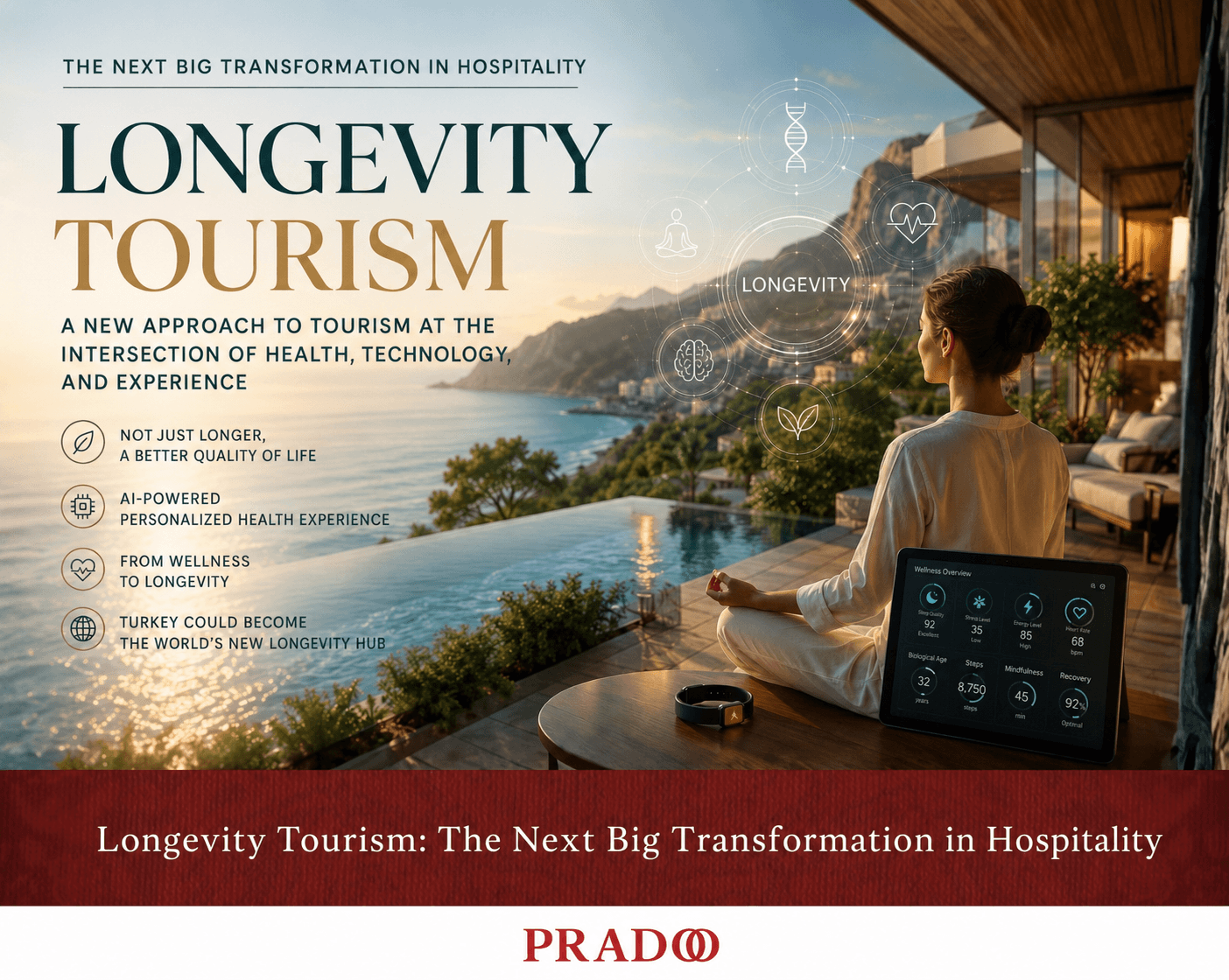
The tourism sector has been selling experiences for many years. However, for the first time, people expect to return from their hotel not only rested but biologically in a better state.
This expectation is the herald of a silent yet incredibly powerful transformation.
The concept of longevity, which we have been hearing increasingly in the worlds of health, technology, investment, and tourism in recent years, is no longer solely the subject of medicine. It sits at the center of a new economic transformation reshaping many sectors, from hospitality and real estate to health tourism and artificial intelligence.
Today, many interpret the concept of longevity simply as living long. However, longevity represents a much grander idea than this.
What is Longevity and Why Has It Become So Important?
Literally, longevity means a long life. However, in the modern world, longevity refers to extending the quality of life rather than just the lifespan.
Scientists are now researching not how long people will live, but how long they can remain healthy, energetic, productive, and independent.
Because while average life expectancy is increasing, chronic diseases are also on the rise.
People may be living longer, but many spend the final years of their lives dealing with health problems.
This is the primary goal of the longevity movement: to change this equation.
The aim is not to live more years, but to live more quality years.
In fact, humanity has been pursuing this throughout history.
From Ancient China to Ancient Egypt, from Greek philosophers to Middle Age alchemists, everyone asked the same question: Is it possible to live longer and healthier?
What has changed today is that this quest is being supported by science, data, and technology for the first time.
The New Luxury is Now Health
There was a time when luxury brought to mind grand villas, private jets, and expensive cars.
Today, for the highest-income individuals in the world, the definition of luxury is changing. Quality sleep, high energy, low stress, mental clarity, a strong immune system, and healthy aging are the new luxury.
Because when money is lost, it can be earned back.
But time cannot be brought back.
Therefore, the world’s most successful entrepreneurs, investors, and executives are now trying to optimize not only their wealth but also their health spans.
This thought lies at the foundation of the longevity economy.
The Transition from Wellness to Longevity
The tourism sector was one of the first to feel this change.
For many years, wellness tourism grew through spa centers, yoga camps, detox programs, meditation retreats, and healthy living hotels.
However, guest expectations are changing now.
Guests do not just want to relax.
They want to measure themselves, see their sleep quality, increase their energy levels, understand their stress levels, and learn their biological age.
Wellness makes a person feel good.
Longevity, on the other hand, aims to make the person truly better.
This is where the fundamental difference between the two concepts emerges.
A New Guest Profile is Emerging in Tourism
The new generation of guests is no longer just buying a holiday.
They are investing in their own health.
Because of this, a new customer segment is forming globally. This group consists of individuals who have a higher income level, are health-conscious, value long-term quality of life, are willing to pay for premium services, and demand personalized experiences.
Especially top executives, entrepreneurs, investors, and professionals are pioneering this transformation.
Because for them, health is no longer a personal matter.
It is a performance factor.
An investment.
A life strategy.
What Will the Hotels of the Future Look Like?
Today’s hotels sell rooms.
Tomorrow’s hotels will sell health spans.
Although this seems like a quite radical change, the process has actually already begun.
In the near future, when a guest checks into a hotel, they won’t just receive a room card.
A health journey will begin.
Sleep patterns will be analyzed, stress levels will be evaluated, nutritional preferences will be examined, and physical activity levels will be measured.
Personalized recommendations will be offered throughout the stay.
Many elements, from room temperature to lighting, will be optimized according to individual needs.
For some hotels, a guest leaving with better sleep might become a more important performance indicator than room cleanliness.
How Will Artificial Intelligence Transform Longevity Tourism?
One of the biggest changes in the longevity field will be experienced through artificial intelligence.
Today, smartwatches and wearable technologies generate millions of data points on heart rate, sleep quality, activity level, stress levels, and dietary habits.
When these data points are analyzed by artificial intelligence, unique health recommendations can be created for each individual.
In the near future, AI-supported digital health assistants may become standard for a hotel guest.
The guest’s needs can be analyzed even before they arrive at the hotel.
They can receive real-time recommendations during their stay.
Even after leaving the hotel, the health program can continue.
Thus, hotels can transform from being short-term accommodation businesses into long-term life partners.
The Era of the Longevity Resort Begins
A new concept is rising globally: The Longevity Resort.
The goal of these facilities is not just to offer a holiday.
It is to create transformation.
When guests arrive at the facility, they undergo comprehensive evaluations where sleep quality is measured, dietary habits are analyzed, and performance levels are evaluated.
At the end of the stay, the goal is not just beautiful memories, but measurable health gains.
This approach could completely change the traditional resort concept.
Longevity Residence and the New Real Estate Approach
Longevity is transforming not only hotels but also living spaces.
The residences of the future will not just be living spaces.
They will be ecosystems that support health through air quality, water quality, natural light, sleep-friendly architecture, walkable areas, and biometric tracking systems.
All of these will become a part of real estate value.
In the near future, the value of a residence could be measured not just by its view, but by the contribution it makes to the quality of life of its residents.
A Historic Opportunity for Turkey
Turkey could be one of the most advantageous countries in the world in terms of longevity tourism.
Because many of the required elements already exist here: a strong hotel infrastructure, the advantage of a four-season climate, international accessibility, advanced health services, thermal springs, sea, nature, and quality of life.
Cities like Antalya, Bodrum, Izmir, and Istanbul could become not just holiday destinations, but international longevity centers in the coming years.
Today, health tourism is being discussed.
Tomorrow, longevity tourism will be discussed.
Today, wellness investments are being made.
Tomorrow, longevity ecosystems will be established.
And most likely, the most valuable hotels of the future will not be those with the largest pools, but those that make the greatest contribution to their guests’ quality of life.
Because the future of tourism is not just about traveling.
It is about living better.
This is exactly why longevity is not seen as a health trend, but as the new story of tourism, life, and human performance.